Home demolition by Israel is a frequent reality of life for thousands of Palestinian people. More than 35% (102 structures) of all structures targeted (demolished and seized) in the first quarter of 2023 were residential, resulting in the displacement of 413 Palestinians, including 194 children, according to Relief Web, whose parent organisation is UN-OCHA.
Studies have revealed high levels of stress was associated with losing a family home during home demolition, and the stress doesn’t only carry out immediate effects but also long-term mental consequences.
Home demolitions can surely lead to multi-faceted negative consequences: family disruptions, mental health problems, et cetera. If we talk about mental health, depression, stress, anxiety, phobias and lack of hope in the future are mutual themes running throughout the lives of those Palestinian families who have actually experienced home demolition along with those who have experienced a constant threat of demolition to their homes.
During the pandemic even this crime did not stop. Israel targeted homes, sanitation, water and hygiene facilities in the occupied West Bank, undermining efforts to curb the spread of COVID-19 at the time, instead causing misery and further vulnerability amongst already crowded Palestinian residential areas.
In addition, many of life stressors such as lack of educational opportunities, low incomes, and a tendency to live in poor housing conditions after and before demolition also play a role in developing serious mental disorders.
Home has such a central meaning in Palestinian culture. Not only a shelter, but it’s also the heart of family life. Inside every Palestinian home there are mutual memories of pain and joy as well as attachment to familiar objects. Palestinians believe in the security of home since they consider being in place, as part of a family, and as a resident in their village and thus part of a broader nation.
Today, tens of thousands of Palestinians carry demolition orders with their hands and live-in fear, and they wonder when bulldozers will arrive to demolish their homes. The hidden message of the bulldozers is a clear command to: ‘Get out. We uprooted you from your homes in 1948 and prevented you from returning, and now we will force you to leave all of the land we have an apparently superior right over than you to.’
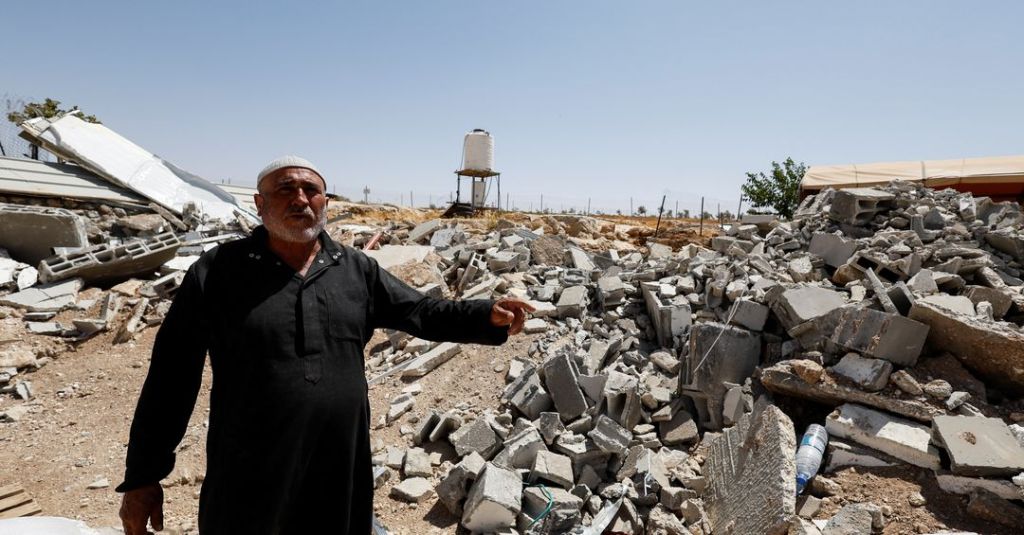
Between 2016 and 2020, 99.1 percent of Palestinian requests for building permits were rejected, according to data provided by the Israeli army’s Civil Administration. So that’s why Palestinians begin to construct their homes anyway, because they are unjustly denied when requesting a permit to build a home on their own land.
Israeli authorities claim Palestinian homes are demolished for various reasons: the land they own has been declared by Israel “open green space;” (see greenwashing) they have no building permit (which Israeli authorities rarely grant to Palestinians); the slope of their land is adjudged as “too steep;” their houses are too near settlements or Israeli only highways (although the houses were there first), out of collective punishment for some action the punished people had nothing to do with, the “clearing” of vast tracts of land for military/security purposes, destruction for the sake of expanding roads, settlements and the “Separation Barriers;” houses “cleared” to make passage safe for settlers or for other security purposes, homes representing “collateral damage,” and more of unjustified causes.
The impact of home demolitions on children can be particularly devastating. Many children affected by demolitions show signs of post-traumatic stress disorder, depression and anxiety. Their academic achievement often suffers, says an UNRWA report watching demolitions.
Demolitions also lead to a significant deterioration in living conditions. Families and communities face increased poverty and long-term instability, as well as limited access to basic services, such as education, health care, water and sanitation.
A significant proportion of the population is vulnerable to forced displacement and disruption of their lives and livelihoods over a prolonged period, given the protracted crisis. Housing demolitions and consequent displacement are often followed by long periods of instability for the family concerned and with many moving multiple times before being able to permanently settle again. Some households wait to return to their original homes, risking being affected again by demolitions, according to a 2021 report by non-profit NGO independent analysis provider ACAPS.
As a result, households deplete their savings or borrow money from family members to cope with displacement and pay for demolitions fees and fines. Some households have a decreased ability to save owing to the diminishing income-earning opportunities in their areas resulting from continuous demolitions of livelihood structures and other economically restrictive Israeli policies, as well as higher dependency ratios, the report continued.
Even those Palestinians who were forcibly displaced over the past decades have found themselves in crowded refugee camps, regularly provoked by Israeli raids, such as the Jenin Refugee Camp, even though it lies in a Palestinians city.
Without the safety net of relying on their families, these households are more likely to experience heightened needs and resort to risky coping strategies after their homes are demolished. Some examples of these coping strategies are sheltering with strangers in public buildings, engaging their children in child labour and child marriage, decreasing health-related expenses, and lower food consumption.
Forced evictions and demolitions violate the rights of the affected people to adequate housing, privacy, and security. More than 73,000 Palestinians in the West Bank are in need of shelter assistance – primarily in Area C, East Jerusalem, and Hebron. In many cases, one demolition order can target multiple structures owned by the same household (including the residence, livestock shelters, and latrines located outside), amplifying the impact for the household.
Demolitions can cause long-term trauma on parents and caregivers, who feel unable to protect and provide for their families. The majority of people lose their jobs after a demolition and face increasing costs of living. In many cases, this has resulted in high rates of irritation and anger, combined with feelings of being distanced from their families, according to Save the Children.
Families that are unable to move in with relatives after their home is demolished have to find immediate shelter in tents or public buildings. If no emergency shelter is available, the families sleep outside. After the initial displacement, some people attempt to return to the site of the demolition in search of belongings that can be salvaged from the debris, including documentation, clothes, and school materials. People affected by the destruction may also return to rebuild their houses.
As of June 2021, 57% of all structures targeted in Area C were seized without (or with very short) prior notice. Affected populations did not have enough time to either object to the order or remove their belongings. As a result, people affected by demolitions often require immediate assistance in the form of clothes. This is especially true for children and women. Bedouin and herding communities in Area C have been displaced multiple times and live in tents, metal shacks, and caves, so that they can gather their belongings quickly, the ACAPS report added.
719,452 Israeli settlers in 2021 lived in settlements illegal under international law, says the Palestinian Central Bureau of Statistics. This number grows annually, but at the cost of Palestinians, indigenous to the land, being forcibly evicted from their homes in an attempt by Israel to ethnically cleanse them from their homeland.
 The Palestine Observer